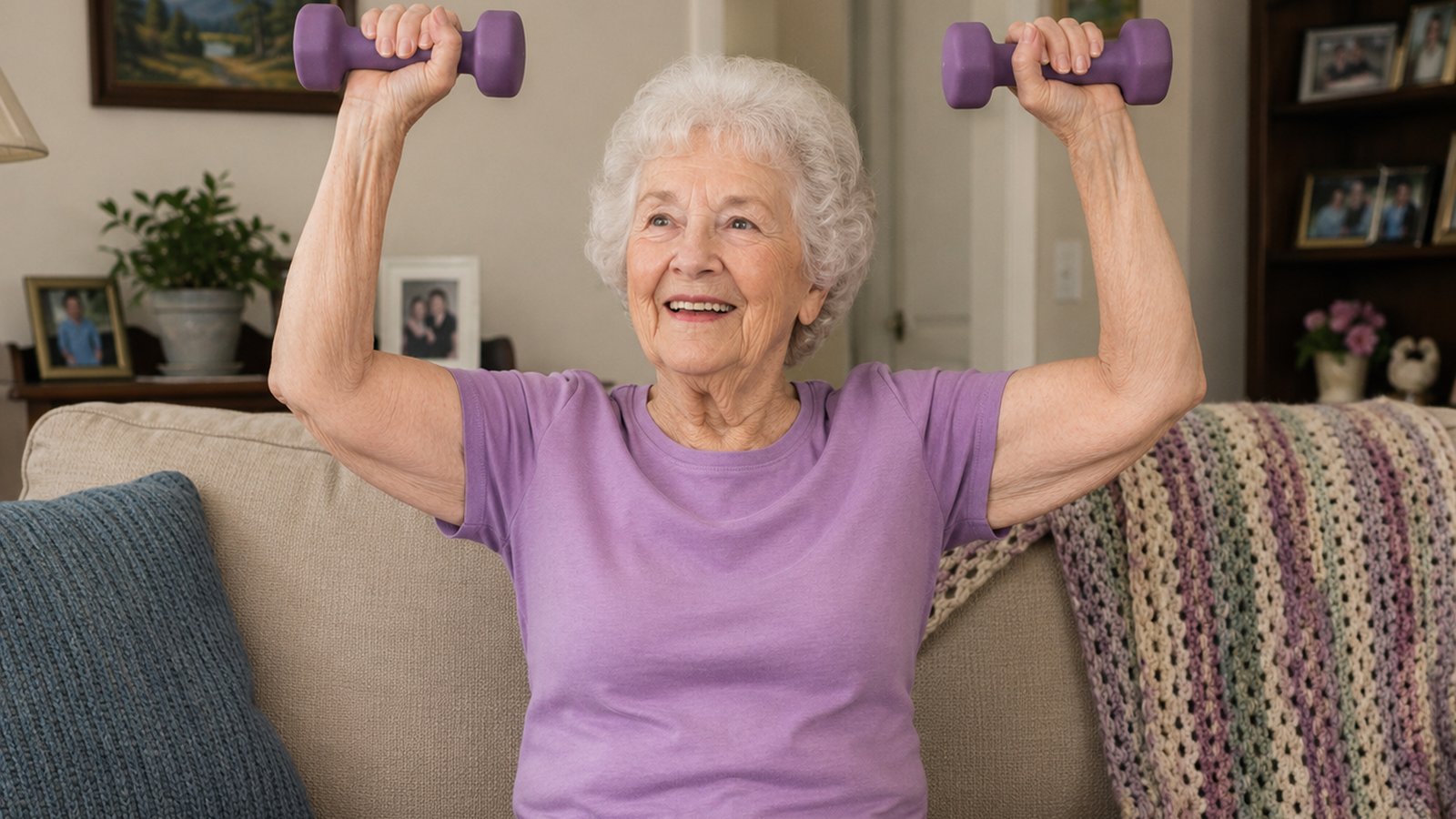
If you're over 70 and have been told that lifting weights is dangerous, that walking is "enough," or that strength training is for younger people, please stop listening to whoever told you that. After three decades of working with seniors, I can tell you with confidence: strength training is not only safe at this stage of life, it's one of the most powerful interventions for staying out of the hospital, out of a nursing home, and in your own life.
The problem isn't strength training itself. The problem is doing it wrong: copying YouTube workouts designed for 25-year-olds, going too heavy too fast, or ignoring the fundamentals in favour of flashy exercises. What follows is the foundation.
Why strength matters more than anything else
From your mid-30s onward, you lose roughly 3–8% of your muscle mass per decade. After 60, that rate accelerates. By 80, most adults have lost so much muscle that everyday tasks, getting out of a chair, climbing stairs, carrying groceries, sit close to the upper limit of what they can do. One bad flu, one fall, one week of bedrest can push them over the edge into permanent dependence.
Strength training reverses this. Not slows it down, reverses it. Even adults in their 90s have been shown in clinical studies to add muscle mass and double their leg strength inside 12 weeks of proper training. There is no medication on earth that does this.
Functional strength is the ability to do real-life tasks without struggle: rising from a low chair, lifting a grandchild, carrying groceries up stairs, getting up off the floor if you fall. The five movements below directly translate to these tasks. That's the entire goal.
The five movements
1. The sit-to-stand
The single most important movement in your life. Practised properly, the sit-to-stand strengthens your quadriceps, glutes, and core, the muscles responsible for keeping you upright. Practised poorly, or not at all, is a huge reason seniors end up unable to live independently.
How: Sit on the front edge of a sturdy chair, feet flat on the floor shoulder-width apart. Lean forward slightly so your nose is over your toes. Drive through your heels and stand up without using your hands. Lower yourself back down with control, fight the urge to drop. Three sets of 8–12 repetitions, three times a week.
2. The wall push-up
Push-ups on the floor are intimidating and often unnecessary for seniors, but pressing strength matters more than you think. It's what helps you push yourself up from the floor if you fall, lift a window open, or push a heavy door.
How: Stand arm's length from a wall, palms flat against it at chest height. Bend your elbows and lean in until your nose nearly touches the wall, then press back. Keep your body in a straight line, no sagging hips. Start with 8 reps, work toward 15. As you get stronger, walk your feet further from the wall to increase difficulty.
3. The single-leg balance
Balance is not a separate skill from strength, it's how strength gets used in the real world. Every step you take is technically a single-leg balance. Most falls happen because the supporting leg couldn't hold its own under load for the brief moment it needed to.
How: Stand near a kitchen counter or sturdy chair. Lift one foot just an inch off the floor and balance on the other leg. Aim for 30 seconds per side. When that becomes easy, try it with your eyes closed (hand still near the counter for safety). When that becomes easy, try it on a folded towel for an unstable surface.
4. The hip hinge
Most lower-back pain in seniors is not a back problem, it's a hip problem. The hip hinge teaches your body to bend forward by folding at the hips instead of rounding the spine. Master this and you protect your back every time you pick something up off the floor for the rest of your life.
How: Stand with feet hip-width apart, soft knees. Place both hands on the front of your thighs. Slide your hands down your thighs as you push your hips backward, keeping your back flat. Stop when your hands reach your knees. Return to standing by squeezing your glutes. Ten slow reps. Once the pattern feels natural, add a light weight (a soup can in each hand) and progress from there.
5. The farmer's carry
The most underrated exercise in fitness. Walking with weights in your hands builds grip strength, shoulder stability, core control, and the cardiovascular base for everything else. Grip strength alone is one of the most accurate predictors of overall longevity in seniors.
How: Pick up two equal-weight objects, start with grocery bags, kettlebells, or even two full water jugs. Stand tall, shoulders back. Walk the length of your hallway and back without rushing. Three to four laps, focusing on posture. Increase the weight as it becomes easy.
How to put it together
Pick three days a week, not consecutive, and do all five movements in the same session. The whole workout takes 25–35 minutes once you know the patterns. You do not need to feel sore the next day; you need to feel slightly tired by the end of the session and noticeably stronger after eight weeks. That is the whole game.
The two things that derail seniors more than anything else are: doing too much too soon (which leads to injury and quitting), and doing too little for too long (which leads to no progress and quitting). The middle path, gradual, consistent, week after week, is where the magic actually lives.
When to get help
If you've had a recent fall, a stroke, a surgery, spinal stenosis, severe arthritis, or any condition that makes you nervous about moving, please don't try to do this alone. The whole reason we exist is to bring this kind of training into your home, customise it around your specific limitations, and make sure every rep is safe. There's a meaningful difference between strength training that's appropriate for seniors in general and strength training that's appropriate for you.
For everyone else: start tomorrow. Five movements, three days a week, no equipment required. In two months, you'll be a measurably different person.
Want help getting started?
Book a free consultation. We'll talk through your goals, your medical history, and design a starting program built specifically around where you are right now.
Book a Free Consultation