This is not physiotherapy, and it’s not gym training. It’s a third thing, adapted, evidence-based personal training delivered in your loved one’s home, designed for bodies that formal rehab has discharged and conventional fitness can’t safely accommodate. Here’s an honest explanation of what it is, who it helps and why it works.
Tap the ones that ring true. Every one of them is a reason families reach out, and exactly the kind of thing we’re built to turn around.
In-home personal training is structured, individualised training delivered by a qualified personal trainer in your loved one’s own home. It combines four things in one programme, adapted personal training, rehabilitation-style exercise, nutrition coaching and lifestyle coaching, all built around their specific diagnosis, abilities, medications and goals.
Every claim below is drawn from a named clinical source. Exercise here is supportive and complementary, it never replaces medical care.
The idea that recovery stops at six months is a myth, the brain keeps “reorganizing and rewiring itself,” and “there is no schedule for stroke recovery.” The AHA/ASA concludes the evidence “clearly supports the use of exercise training… for stroke survivors” at every stage. Heart & Stroke Foundation of Canada; Billinger et al., Stroke, 2014
Movement is no longer something to avoid, current guidelines recommend supervised exercise and education as first-line conservative care, and because excess weight worsens symptoms, losing it brings relief. Cleveland Clinic; clinical practice guidelines, 2024
Guidelines recommend at least 20 minutes of moderate-to-vigorous aerobic exercise twice weekly plus strength work for each major muscle group, and sound adaptive training protects the shoulders used for transfers and wheeling. Martin Ginis et al., Spinal Cord, 2018; NCHPAD
When accident-benefit rehab ends, pain and deconditioning often remain. Exercise- and mobilisation-based therapy carries the strongest evidence for reducing whiplash-related neck pain and disability. NIH/PMC2975531; systematic review & meta-analysis, 2021
After 50, muscle mass falls 1–2% a year and strength faster still, but resistance training with adequate protein (at least 1.0–1.2 g/kg/day for healthy seniors) is the proven countermeasure, and the loss can be slowed or even reversed. von Haehling et al., 2010; ESPEN, 2014; Cleveland Clinic
Falls are the leading cause of injury-related hospitalisation among Canadian seniors. Structured strength-and-balance training works: the home-delivered Otago Exercise Programme reduces falls by 35% among high-risk seniors. Public Health Agency of Canada; Frontiers in Public Health, 2017
Once told to avoid exertion, people with MS are now encouraged to move, activity “can help ease MS symptoms, improve mobility, and enhance quality of life,” with no evidence it triggers relapse. Programmes must respect fatigue and heat sensitivity. MS Canada
For hip and knee osteoarthritis, exercise isn’t optional, guidelines recommend exercise, education and weight management as first-line care, and those who respond progress to joint-replacement surgery less often. ACR/Arthritis Foundation; ScienceDirect, 2023
Resistance and weight-bearing exercise build and protect bone, while strength-and-balance work reduces the falls that cause fractures, trained safely, steering clear of the high spinal-flexion postures that raise fracture risk. Brooke-Wavell et al., “Strong, Steady and Straight”; Mayo Clinic
Coaching adaptive athletes means applying core strength-and-conditioning principles, overload, progression, specificity, through the lens of each athlete’s classification and impairment, protecting against injury while building genuine sport-specific performance. Sportsmith; Physiopedia
Not a stack of add-ons. One coordinated program that treats the whole person, and takes the weight off your shoulders.
Every session designed around their condition, their space, and their goals, progressed safely as they get stronger.
Nutritional help including recipes and guidance
We teach you and any caregivers safe transfers, fall-proofing, and how to support practice between visits.
Walking speed, sit-to-stand reps, grip and balance, re-tested every 6–8 weeks so you can see the gains, not just hope for them.
We work inside the limits your physician, physio and specialists set, never around them. Clearance first, always.
No transport, no gym membership, no exhausting outings, just a knock at the door.
When a loved one is declining, there are really only three paths. Here’s what each one tends to look like a year from now.
We come to you. We watch them move through their space, review their history, and tell you honestly if we can help, about an hour, no obligation.
We confirm medical clearance and build a plan around their condition, their home, and the goals that matter most to your family.
Sessions happen at home on a steady schedule.
Extremely common, and we’re used to it. The free assessment is low-pressure and happens on their turf, which disarms a lot of the resistance. Many people who “don’t want a trainer” warm up quickly once it’s a friendly, capable person in their living room rather than a gym they have to be dragged to.
Safety is the whole point. We require medical clearance before starting, work strictly inside the limits your doctors set, and design every movement around what their body can do today. Roughly one in five assessments ends with us recommending something else, we won’t train someone who shouldn’t be training.
Always. We pick up where physiotherapy ends and stay within whatever boundaries the medical team has set. If the physio wants a movement avoided, we avoid it. If the cardiologist set heart-rate limits, we respect them.
That’s often exactly where we start. Foundational work can begin from a chair or wheelchair using bodyweight, a sturdy surface for balance, and light bands we bring. We meet the body where it is and expand the boundaries from there.
The in-home assessment is completely free. We’ll walk you through session pricing and packages during that visit so it fits your family’s situation. Depending on your plan, services may be claimable under certain private or extended health benefits, we’ll point you in the right direction.
We cover the Greater Toronto Area. The fastest way to confirm we reach you is a quick call or message, give us your neighbourhood and we’ll tell you right away.
Very little. Adil brings a small, portable kit, resistance bands, adjustable dumbbells, ankle weights, a stability aid, and uses the furniture already in the home: a sturdy chair, a countertop, the stairs. The home becomes the gym, which is exactly the point.
Most clients train one to three times per week, depending on their condition, goals and energy. Even two strength sessions a week meaningfully build capacity, and two to three drive the fall-prevention and strength gains the research describes.
Yes, it’s built in, not sold separately. For seniors that usually means getting enough daily protein to protect muscle; for clients managing weight alongside a condition like spinal stenosis or arthritis, sustainable fat loss directly reduces load on the spine and joints.
Every programme starts with a baseline and is tracked against functional benchmarks that matter in real life, rising from a chair, balance and walking, grip, the weight they can move, confidence on the stairs, reviewed and progressed as they improve.
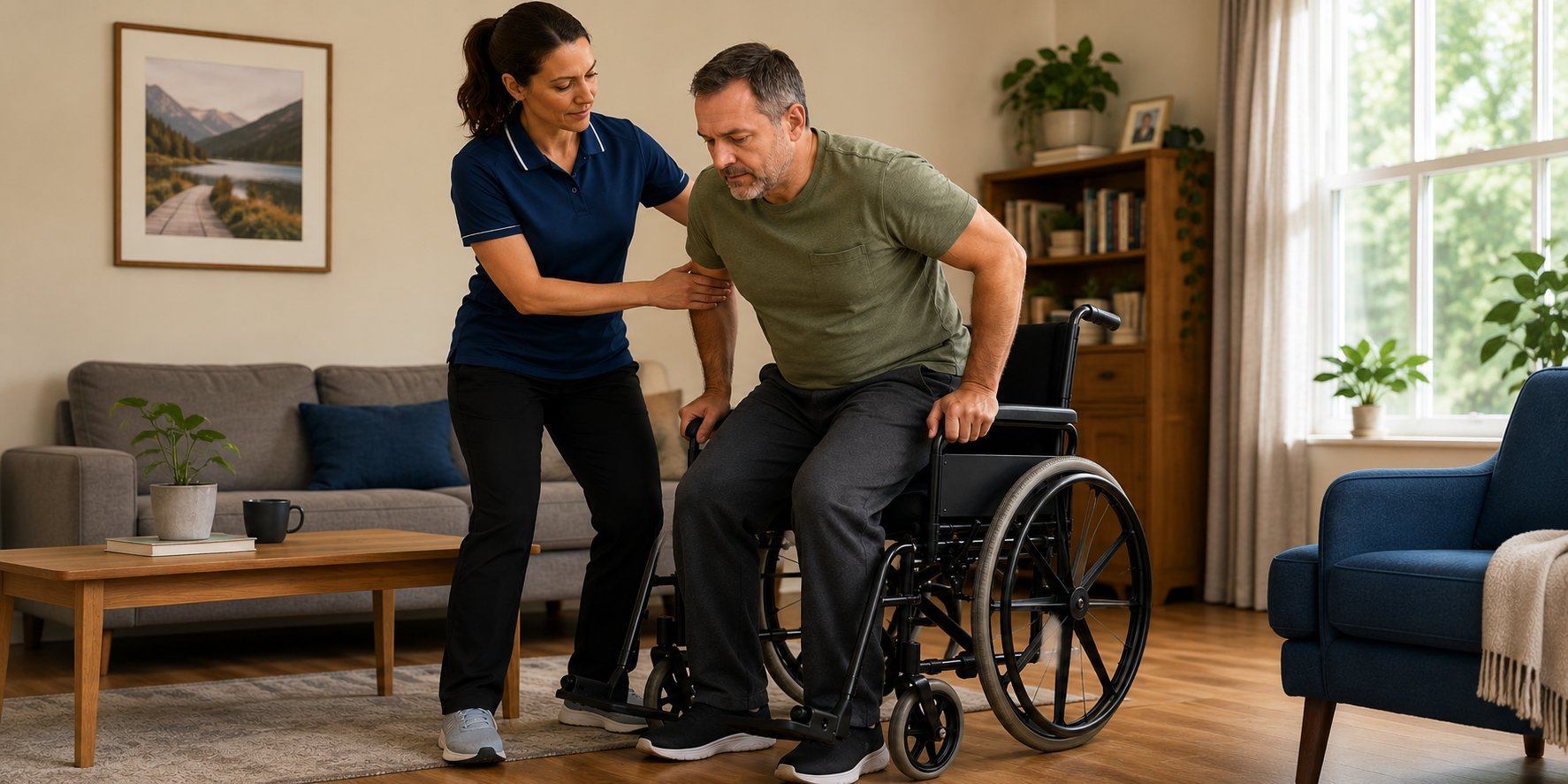
One hour, in their home, no obligation. We’ll look at their space, talk through their condition, and tell you honestly whether we can help, and where to start.